Unit costs rise. Shelf prices don't.
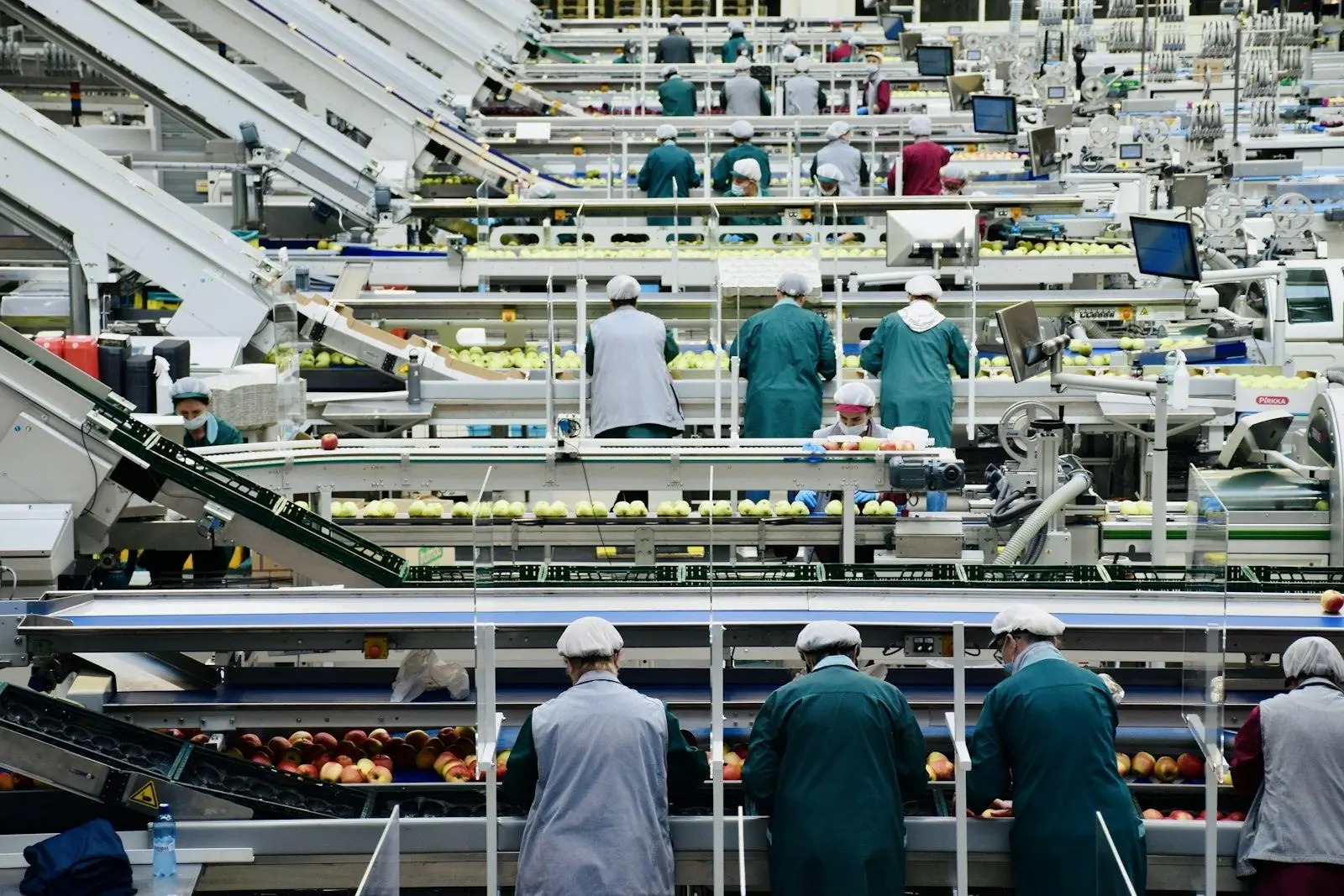
A factory runs on flow: raw materials come in, move through departments and shifts, and quality is decided at every workstation. In 2023, Romanian manufacturing had about 78,000 companies and 1.1 million people, an average of 14 per company. The food industry alone counted 13,545 companies and almost 169,000 people.
The past five years
Between 2021 and 2025, food industry output grew by 17%, more than five times faster than the European average, and machinery and equipment output by 15%. In the second half of 2022, electricity for medium-sized business consumers reached EUR 0.357 per kWh, 70% above the EU average, and the price stayed capped until mid-2025. In the first nine months of 2026, manufacturing produced 4.7% less than last year.
Today's challenges
- Energy, uncapped.Since July 2025, companies have paid market prices for electricity, and since April 2026 for gas as well. For these companies, the electricity price went from 15% below the EU average in 2024 to 3% above it in 2026. In September 2026, industrial producer prices were 13.8% higher than a year earlier, and those for energy 25% higher. Refrigeration, pasteurization, ovens and paint shops must be re-costed every month.
- People: fewer and more expensive.The agri-food tax breaks, granted until 2028, were scrapped as of January 2025. The minimum wage rose to 4,325 lei in July 2026, and the quota for non-EU workers fell to 90,000. The night shift is increasingly hard to staff, and new hires learn on the job.
- The low-wage advantage has run out.In 2023, a worker in Romanian manufacturing produced a third of the value added of a worker in the EU, and in the food industry, less than a quarter. Cost per employee was likewise a third of the European average. Any pay rise not backed by output standards, flow or automation comes straight out of the margin.
- The shelf dictates, packaging adds cost.Food imports exceeded EUR 11 billion in 2025, with a deficit of almost EUR 4 billion. Large retail chains obtain discounts of 20–40%, and the markup on 17 staple foods remains capped until the end of 2026. From August 2026, the EU packaging regulation also applies.
- Wine and equipment: shrinking markets.World wine consumption fell in 2025 to its lowest level since 1957, and the US taxed European wine at 15% from August 2025 and at about 10% in 2026. German industry, Romania's largest foreign customer, produced 6% less in 2025 than in 2021. Equipment orders come in surges, with rush jobs on top of regular runs.
No factory controls the market. But it does control what happens in the flow: cost per product, recalculated when energy or wages change; output standards per workstation that people believe in; acceptance criteria at every workstation, not just at the end; a clear person in charge between departments and on every shift.
SourcesEurostat (industrial production, 2021–2025; electricity prices for businesses, 2022–2026; business statistics, 2023) · National Institute of Statistics, INS (industrial production, January–September 2026; industrial producer prices, September 2026; international trade, 2025) · Romanian Competition Council (milk market, June 2026) · OIV (world wine market, May 2026) · Destatis (German industrial production) · Romanian Government (minimum wage, July 2026; foreign worker quota for 2026; Emergency Ordinances 6/2025 and 12/2026) · European Commission (packaging regulation) · WineNews and US Wine Trade Alliance (US tariffs on European wine, 2026)